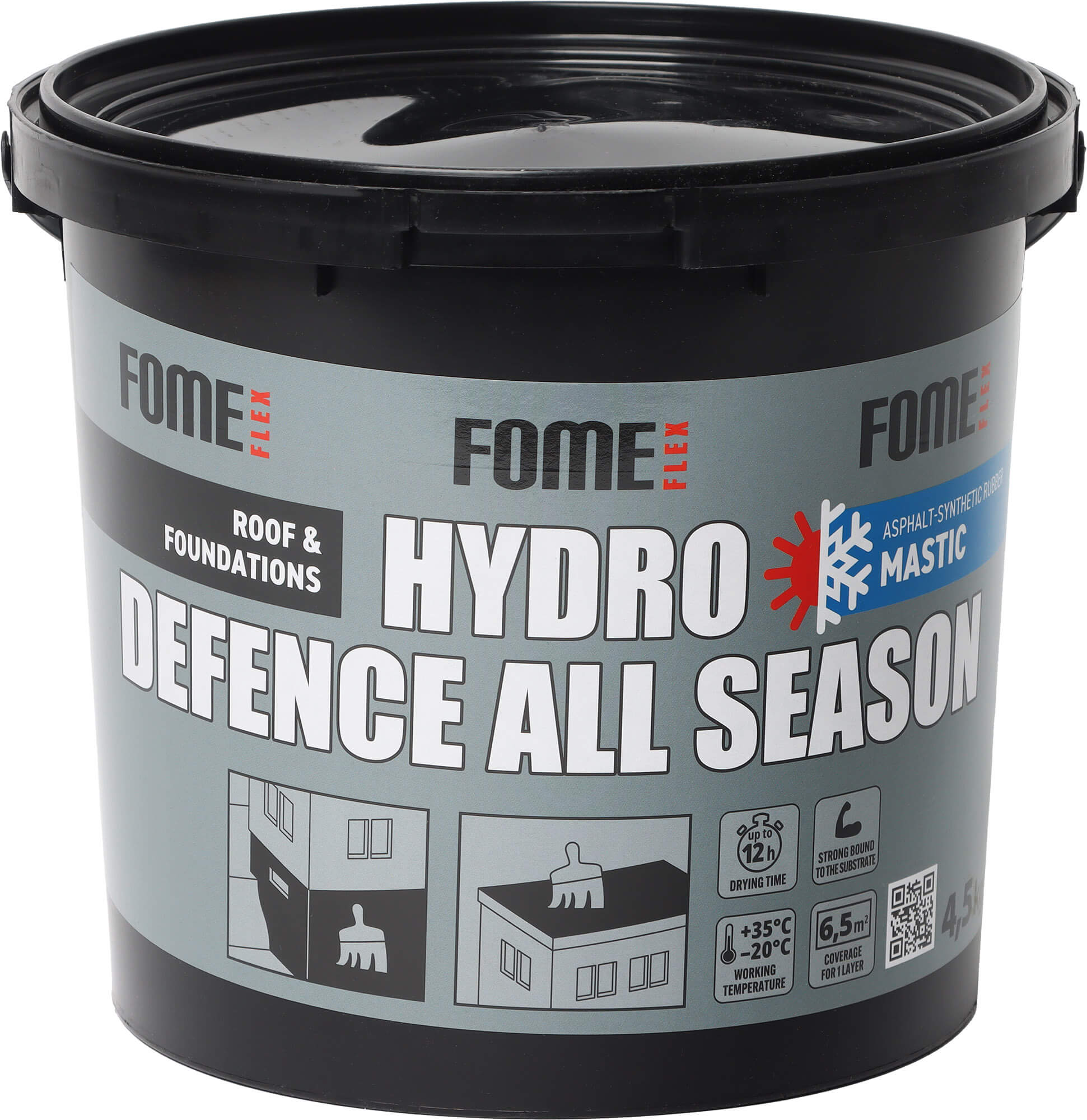
FOME FLEX HYDRO DEFENCE ALL SEASON mastic (4,5 kg) is slightly modified with synthetic rubber and special additives that increase the elasticity of the final coating. Suitable for waterproofing foundations, balconies and flat roofs (according to EN 1928:2000). Can be used on wet surfaces. Suitable for use during all seasons. This bituminous mastic protects construction elements from moisture influence. This product also can be used in bridge construction to protect metal surfaces from corrosion.
Application areas
- Old roof felt maintenance & refurbishment
- Applying waterproofing coatings on horizontal and vertical surfaces
- Protecting construction elements from moisture influence
- The product can be used in bridge construction to protect metal surfaces from corrosion
Norms / Atests / Certificates
The product meets requirements of:
PN-B-24620:1998
PN-B-24620:1998/Az1:2004
Surface preparation
The pull-off strength of the substrate shall be at least 1.0 MPa. Concrete substrate must be unfrozen and unfrosted; concrete in air-dry condition, without visible large damp patches. The substrate must be clean and free from loose particles, dust, oil, grease and other contamination. Metal surfaces must be cleaned of rust, old paint, grease and other contaminants prior to application.
Prime the surface with FOME FLEX HYDRO DEFENCE ALL SEASON Primer.
Product preparation
Apply cold. During cold weather, to facilitate work it is recommended to put the container with the product in a warm room for 1-2 days. Mix before use.
Application
The product can be applied with brush or roller. Apply the first layer by rubbing into substrate with broom or brush (before applying following layer make sure the previous one is dry).
- Foundations, underground parts of the building, hydrophobic insulation under floor pavement – put the mastic in 2-3 layers depending on estimated water amount. In case of “hard” terrains (ground movement, exposed to big amounts of water etc.) it is recommended to put 3 layers and use additionally reinforcing mesh embedded into 2 layer.
- Flat roofs coating – put at least 3 layers of mastic, embedding into 2 layer reinforcing mesh; fold the mesh on vertical elements on the roof. In order to prolong the coating life it is recommended to scatter the coating with grit.
- Roof coverings preservation – put at least 2 layers of mastic. In order to prolong the coating life it is recommended to scatter the coating with grit.
- When waterproofing, it is recommended to dip sealing tape or technical fabric along the joints and corners.
- In the case of damp proofing or waterproofing on surfaces of civil engineering structures which are partially covered with soil, e.g. bridge supports or retaining walls, the waterproofing must also be carried out on surfaces which are not covered with soil up to a height of approx. 30 cm above ground level.
- In the case of heavy-duty waterproofing, including waterproofing under pressure, a reinforcing liner made of technical fabric must be used on the insulated surfaces.
Works after completion of application
Clean tools with bituminous cleaner or organic solvent.
Remarks / restrictions
When working, wear protective clothes, goggles and gloves.
DO NOT WASH HANDS WITH SOLVENTS.
- The product contains organic solvent, should not be used indoors, and outdoors in areas in direct contact with the living area, such as on balconies and terraces above ground level.
- Avoid contact with tar and paper tar.
- Do not use in contact with polystyrene foam.
- Do not heat.
- Recommended to conduct tests in an inconspicuous area.
- Do not use on building elements exposed to negative water vapour pressure (negative water vapour pressure), which may lead to detachment of the insulation or formation of blisters in the completed coating.
- The completed coating should not be subjected to rope or point loads, as this may break the continuity of the insulation.
Product is packaged in 4,5 kg pails. Store up to 18 months in originally sealed containers. Containers should be stored upright away from sources of fire and heating elements, in conditions which protect them from sunlight and improper weather. Can be stored at sub-zero temperatures.
Allowable negative transport and storage temperature of -30 °C for a continuous period of 5 weeks. Allow 4 cycles of freezing and thawing at the allowable negative temperature.