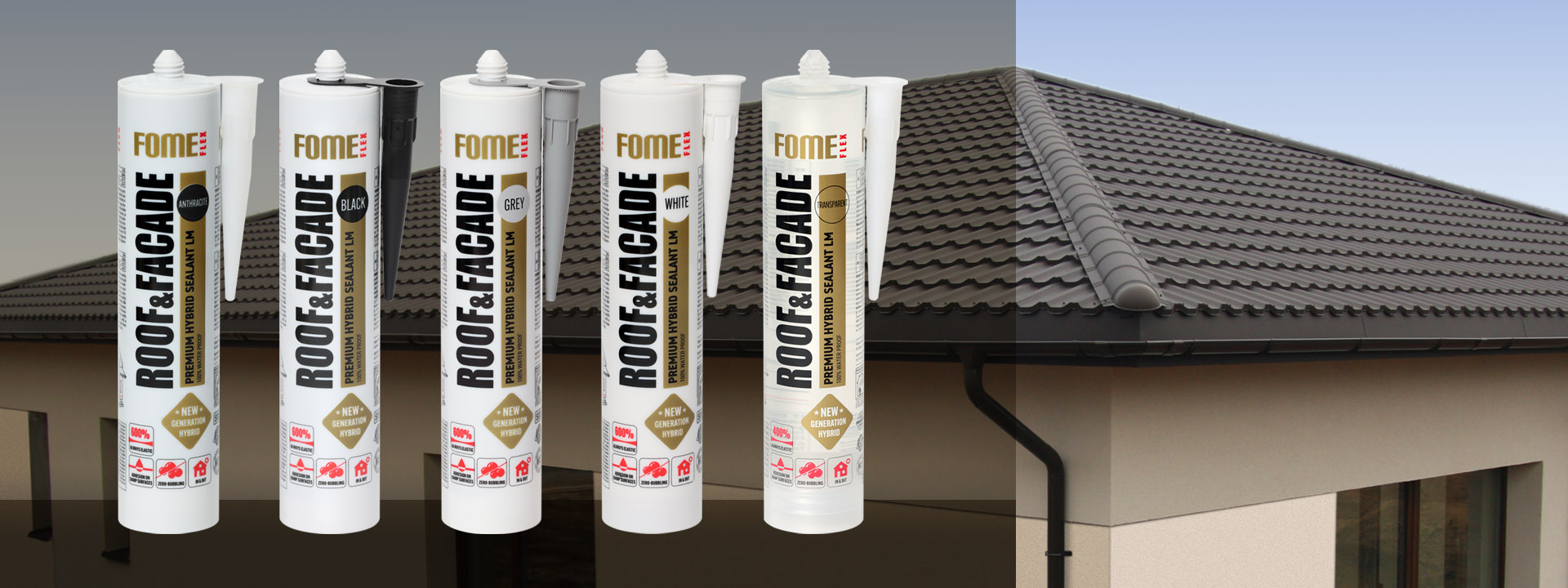
A common challenge for builders during construction work is how to reliably seal structural and expansion joints in facades, roofs or walkways. We offer a professional, high-quality and advanced solution – Fome Flex ROOF & FAÇADE sealant. A new generation, low modulus hybrid façade and roof sealant forms an extremely elastic and durable seam on commonly used building materials. Learn more about the technology behind Fome Flex ROOF & FAÇADE and why it is unrivaled in the market.
What is Roof Sealant and Why Is It Important?
Roof sealant is a protective coating applied to a roof preventing leaks, sealing cracks and extending the lifespan of the roofing material. Sealants are used for maintenance, waterproofing and weatherproofing. Different types of sealants are used depending on the repair context. Hybrid sealant cures with moisture in the air and is designed for superior elasticity and mechanically more durable than traditional products. Therefore, roof repairs are more durable and faster – the hybrid sealant cures fast and it is resistant to UV light or other atmospheric influences.
Why Choose Low Modulus Sealant for Facade and Roof Sealing?
Low modulus sealant has high flexibility and can stretch or compress significantly without cracking or loosing adhesion. Hybrid sealants with low modulus, such as Fome Flex ROOF & FAÇADE, are better for facades or roofs repair because they perform well in harsh weather and maintain elasticity. These sealants are suitable for dynamic joints, such as curtain walls, expansion joints or roof perimeters.
Roof Repair Sealant for Structural and Expansion Joints
When choosing a roof repair sealant specifically for structural and expansion joints, it’s important to select a product that remains flexible, durable, UV-resistant, and weatherproof. These joints experience movement from thermal expansion, settlement, and structural loads, so you need a high-performance sealant that does not shrink and has high elasticity.
Weatherproof Protection for Roof Leak Repair and Prevention
Fome Flex ROOF & FAÇADE hybrid sealant creates joints that are weatherproof. This sealant adheres well to most commonly used building materials without a primer even when they are damp. It prevents roof leaks and repairs cracks that might appear between roof joints.
Eco-Friendly and Odourless Sealant Technology
The advanced hybrid formula used in creating Fome Flex ROOF & FAÇADE sealant is harmless to human health and is virtually odourless. These sealants do not contain isocyanates, solvents or silicones; therefore, they are environmentally friendly.
Also, ROOF & FAÇADE sealants are certified with CE certification and other important certifications recognized in the construction market:

For these reasons, “Fome Flex HYBRID ROOF&FAÇADE” is unrivalled in the market as a new-generation, low-modulus, premium hybrid sealant.
Key Benefits of Fome Flex ROOF & FAÇADE Roof Sealant
While here are many high-quality sealants out there in the market, new generation professional hybrid sealants do have advantages as it is developed specifically for construction and expansion joints in facades, roofs and pedestrian walkways. Key benefits include:
- Curing without bubbles,
- Completely safe for people and the environment,
- Almost odourless,
- Free from isocyanates, solvents or silicones,
- Permanently elastic,
- Suitable for wider connections,
- Highly resistant to UV,
- High initial adhesion,
- Exceptional mechanical strength.
Primer-Free Adhesion on Wet and Dry Surfaces
Fome Flex ROOF & FAÇADE is developed for outdoor jobs like sealing building façades or repairing roof seams. Unlike some other sealants, it works well even when the weather isn’t perfect. It sticks strongly without needing a primer and can be applied to both dry and damp surfaces, making it reliable in changing conditions.
No Shrinkage or Bubbles During Curing
Unlike older generation sealants, Fome Flex ROOF & FAÇADE never bubbles when cured in the sun. The product is low modulus meaning the elasticity remains high after curing. Since it’s used outdoors and exposed to temperature changes, it’s important that the joints don’t shrink over time. This flexibility helps the sealant move with the joint without cracking or pulling away.
High Mechanical Resistance and Long-Term Performance
The advanced technology of Fome Flex ROOF & FAÇADE hybrid sealant offers high mechanical strength needed for heavily used pedestrian walkways. The resistance makes maintenance easier and guarantees joint quality will remain unchanged for a long time.
How to Apply Roof Sealant?
All construction jobs require proper surface preparation before starting. In order to achieve the expected quality of the joints, making sure the temperature is between +5 °C and +40 °C is key. Also, it is crucial to have the right type of sealants and tools for the task.
· Surface preparation before sealing
Before starting the sealing process, all the surfaces must be clean and free from grease. That ensures proper adhesion to the surfaces.
· Application instructions and tools
When the surfaces are ready, cut the end of the cartridge and screw the nozzle on it. Insert the cartridge into the caulking gun and fill the nozzle with sealant by pressing the trigger on the gun several times.
· Recommended joint dimensions and curing time
The joint depth should always be in the correct ratio of the joint width up to 10 mm is 1:1, with a minimum of 5 mm in width and depth. For joint wider than 10 mm, the depth is the width divided by 3 plus 6 mm.
Fome Flex ROOF & FAÇADE hybrid sealant hardens quickly with full curing time of 2-3 mm per day.
Frequently Asked Questions
Silicone and hybrid sealants (such as MS polymer or STPU) are ideal due to their superior flexibility, UV resistance, and durability in harsh weather conditions.
Yes, applying a roof sealant helps extend the lifespan of the roof, prevents leaks, and reduces ongoing maintenance expenses.
Yes, when properly applied, roof sealants effectively seal leaks and prevent water penetration.
Roof cement is a thicker, asphalt-based material primarily used for patching. Roof sealant, by contrast, is more elastic and flexible, designed to seal joints and cracks.
Drying time typically ranges from 24 to 48 hours, depending on the sealant type, application thickness, and weather conditions.
High-quality roof sealants can last between 10 and 20 years, depending on environmental exposure and the materials used.
Begin by cleaning the surface thoroughly. Apply primer if required, then use a caulking gun to fill joints with sealant, and smooth the material with an appropriate tool.
Fome Flex PROFI WIPES are impregnated and have abrasive surface which helps to clean sealant residue from hands or tools. It is dermatologicaly tested and neutral pH.
Hybrid sealants combine the elasticity of silicone with the strong adhesion and paintability of polyurethane, providing enhanced weather resistance.
Yes, if the product is specifically rated for both applications—such as Fome Flex ROOF & FAÇADE or similar hybrid sealants.
It provides excellent resistance to UV rays, rain, and temperature fluctuations, making it well-suited for year-round exterior use.
Yes, it is specifically formulated for use on flat and felt roofing surfaces, providing durable and reliable sealing.
Conduct annual inspections, clean the joints, remove any damaged or deteriorated sealant, and reapply as needed to address any cracks or gaps.
Rekomenduojami produktai
-

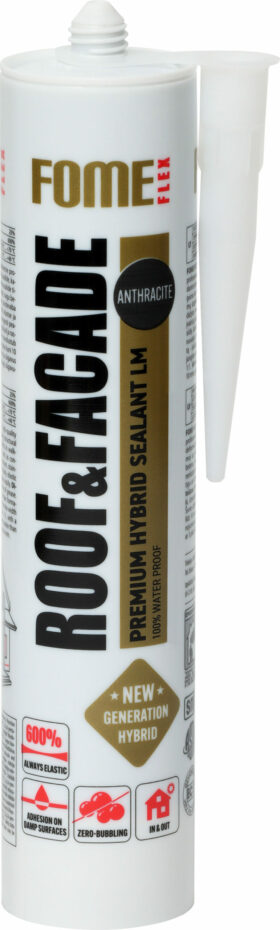
FOME FLEX ROOF&FACADE Professional Hybrid Sealant, Anthracite, 300 ml
-
FOME FLEX ROOF&FACADE Professional Hybrid Sealant, Black, 300 ml
-
FOME FLEX ROOF&FACADE Professional Hybrid Sealant, Grey, 300 ml
-
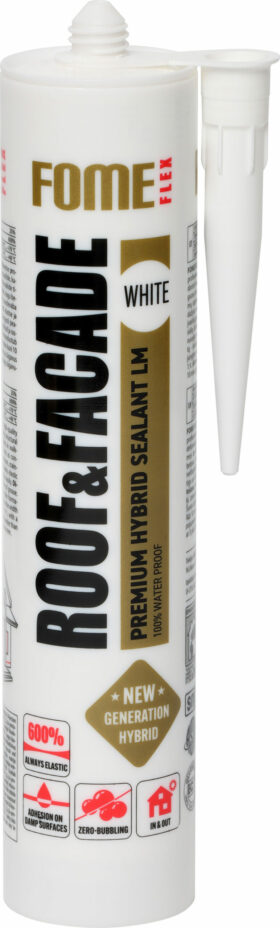
FOME FLEX ROOF&FACADE Professional Hybrid Sealant, White, 300 ml
-
FOME FLEX ROOF&FACADE Professional Hybrid Sealant, Transparent, 300 ml